
Remote Sensing
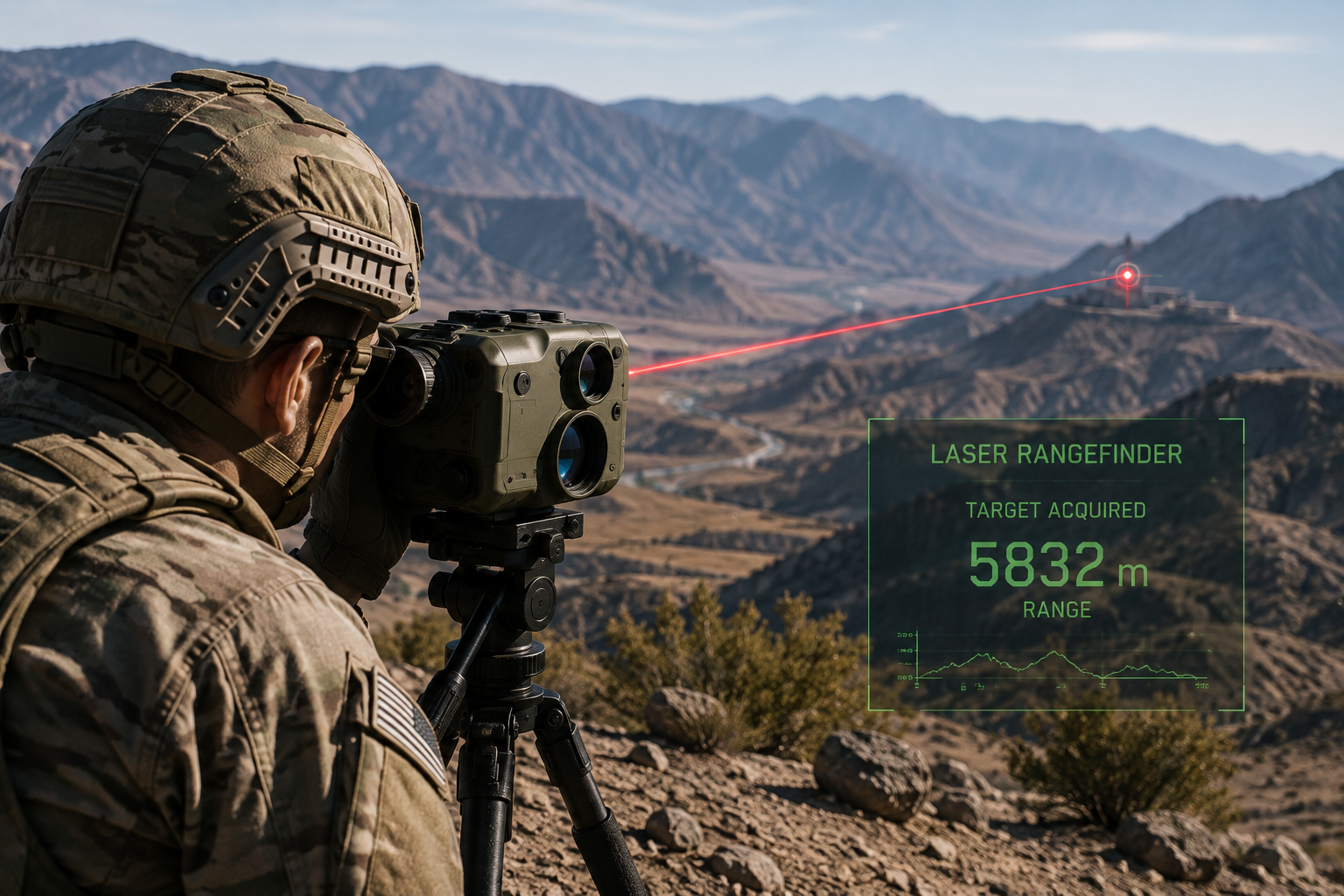
Remote Sensing Lasers have many different applications, both military and scientific. When looking at range finding lasers, here are a few helpful definitions:
- Auto-Sense Range Finding: Auto-Sense Range finding combines laser ranging with automated detection and signal processing systems to determine the distance to objects within a scene.
- Beam Divergence: The angular measure of how much a light beam spreads out as it moves away from the focal point. See our Beam Divergence Calculator
- Flash LIDAR: Flash LIDAR illuminates a large area with a single laser pulse and captures the reflected light using a two-dimensional detector array, allowing an entire three-dimensional scene to be measured simultaneously. High-energy pulsed solid-state lasers are useful for providing the illumination required to obtain measurements at extended ranges. Applications include 3D imaging, navigation, autonomous systems, mapping, and reconnaissance.
- Imaging: Creation of controlled illumination for specialized systems where conventional illumination is insufficient. This method uses short energetic laser pulses to illuminate distant objects while synchronized detectors capture the reflected light.
- Laser Target Designation: Laser target designation uses a precisely directed laser beam to identify or mark a target for detection by another optical system.
- LIDAR: LIDAR stands for Light Detection and Ranging. This is the method for using laser pulses and the reflected signals to determine the distance, size and characteristics of objects, terrain, or atmospheric conditions. This method is useful for applications such as topographic mapping, atmospheric research, remote sensing, obstacle detection and surveillance.
- Q-Switch: A Q-switch acts as a fast shutter inside of the laser resonator. By holding off the energy, the Q-Switch releases a single pulse in a short period of time (typically nanoseconds). This allows for the lasers to achieve high peak powers.
- Range Gated Imagery: this method uses short pulses with a synchronized camera that is only activated during a specific time interval after each pulse. This method allows the system to isolate objects while reducing the foreground and background reflections. This method can be useful for challenging atmospheric conditions (fog, snow, smoke).
- Ranging: Laser ranging determines the distance to an object by transmitting a short laser pulse and measuring the time (Time of Flight) required for the light pulse to return.